




New Trade Zone
Trade Zone is now live
Use the new Trade Zone for auctions and instant-price trades so Pokemon and item offers are easy to find.


Lacomus
Registered User
-
Joined
-
Last visited
Everything posted by Lacomus
-
@Shadowgon @Princekashyap @Sendo69 @C1qiqibtw @Kairu @Mitesx21 @Sesosojito @Kaikaishin1990 @Codonhut1dieu @Ram17 https://discord.gg/qBs73D7VrD
-
The brackets are made. Hopefully you’re all in the tournament server by now. There’s only so much I can do to make sure everyone gets in. If you need any help, I’ll be in the tournament server as well, so just give me a shout. If you’ve signed up and you’re not in the server yet, get in there ASAP. You’ve got 4 days from today to organise and play your first-round game. Good luck everyone.
-
For everyone who’s signed up, hopefully you’re already in the tournament server and ready to be tagged for your matches. If you haven’t joined yet, please make sure you get into the server now. Once the brackets are created tomorrow, you’ll be able to see who your opponent is. From there, you’ll have a total of 4 days to arrange and play your match before the next round. Please make sure you communicate with your opponent and get your match sorted within that time. If you don’t show up or make an effort to arrange your game, you’ll be forfeited. Get into the server early, keep an eye out for the brackets tomorrow, and be ready to arrange your match. https://discord.gg/qBs73D7VrD
-
@Vicrow Yes.
-
Just to clarify to everyone: if you haven’t tagged me in the PRO Discord, you’re not entered. Discord makes everything much easier to manage. If you’ve already tagged me, you’re all set and will receive your first hunt tag later today. If not, please do so.
-
@R0ckst4r @Vicrow If you’ve tagged me with “in” in the PRO Discord, I shall register you both.
-
Username: Lacomus Server: Gold Country/Timezone: UK / UTC+1 (BST)
-
This is a Reinders-sponsored event with free entry for all participants. 🦌 The tournament will be played on Pokémon Showdown and will include the Mega Evolutions from the suspect tester, alongside the usual PRO Ranked PvP rules. In addition to the 10m prize pool, with payouts awarded to 1st, 2nd, and 3rd place, the tournament winner will receive a permanent Champion title role in the PRO Community Tournament Hub Discord, recognising them as a winner of one of our free-entry community tournaments. Tournament Information 1. Format The Tournament will consist of a double-elimination bracket. The bracket will be randomly seeded. Registration will begin now, and will close on Sunday, 4th October 2026 at 12:00 PM BST (UK time / UTC+1). Early sign-ups help us stay ahead of the curve and let us start the tournament right away. All matches prior to the Finals on both brackets will be best of 3. Winner's Bracket Finals, Loser's Bracket Finals, and Grand Finals will be best of 5. Loser Bracket winner has to win 2x Bo5 against the winner bracket winner in order to win the tournament. 2. In Battle All Ranked PvP Rules apply. Ranked PvP Rules - PRO Rules - Pokemon Revolution Online The tournament will be hosted on Pokémon Showdown, with the Mega Evolutions included from the suspect tester permitted, alongside the usual PRO rules. In the event that any Ranked PvP Rules are changed while the tournament is in progress, the change takes effect immediately in this tournament as well. Should any moves, abilities, Pokemon, or items be coded between the start of the tournament and its end, those moves, abilities, Pokémon, or items may not be used. Should any Ranked PvP Rule be broken, the offending player will forfeit the game. Should either player disconnect, the other player may either claim a game victory or allow a rematch at their discretion. Should the server crash during the game, a rematch is to be played with the same teams, unless a player demonstrates that they were in a position where they could not reasonably lose the game. Registration 1. How to Register Fill out the following format and make a post in this thread. Username: Server: Country/Timezone: Example: Username: Lacomus Server: Gold Country/Timezone: UK / UTC+1 (BST) If you haven’t joined the PRO Community Tournament Hub yet, you’re welcome to join. Whether you’d like to participate in this tournament, get involved in future tournaments and games, or join as a guest and watch the action, everyone is welcome. The server is open to all: https://discord.gg/qBs73D7VrD Prize Pool & Payouts This is a Reinders-sponsored event with free entry and a total prize pool of 10m. The prize pool will be awarded to the Top 3 players as follows: 🦌 1st Place: 5m (50%) 🦌 2nd Place: 3m (30%) 🦌 3rd Place: 2m (20%) Total Prize Pool: 10m

-
-
@Tantankare67 @Vicrow Tag me on the PRO Discord at “lacoisi” and I’ll register you both.
-
I’m hiding somewhere in PRO. Find me first and win 1m Pokédollars. I’ll be running several games, with 1m Pokédollars on each find, until October 4th at 12:00 PM BST (UTC+1). Want in? Tag me with “In” in the PRO Discord...not here in this thread. You’ll get a direct tag whenever a hunt starts, giving you a much better chance of seeing it in time. It also means you won’t have to keep checking or signing into the forum and risk missing a hunt. Overall, Discord will be much better for taking part. Once per day, at a random time, I’ll tag everyone taking part, announce how long I’ll be online, and post a map with a box marking the general area I’m hiding in. You won’t get a specific city, route, etc...with several people searching, that would make it far too easy. I’m somewhere inside the box. Find me. My hiding spot changes every game. Hunts take place on the Gold Server using my main account, with the 1m prize paid on Gold. Silver players are welcome. Transfer over or use a Gold alt to play. Only players signed up and tagged for that hunt can claim the prize. If you miss one, you’ll be tagged again next time. Please don’t reply “In” to this thread. Tag me in the PRO Discord instead.

-
If you're new to PRO and you've reached the point where you need to buy the bike but you're short on funds, send me a message and I will cover the cost. If you're unsure about the bike or how to obtain it, you can check the Bike Quest guide on the PRO Wiki here: Cerulean City - Pokémon Revolution Online Wiki. You need at least your 4th badge to trade. I can only trade on the Gold Server. If you're on Silver, you'll need to transfer through the dashboard to claim it. You get one free server transfer every 30 days, so it's up to you whether you feel it's worth using. This offer is specifically for players who are at the bike stage and need the funds to purchase the bike. The offer is open to all players who meet the above requirements and will remain available until Sunday, 4 October 2026 at 12:00 PM (UTC+1 / BST). If you're at this stage and could use the help, just drop me a message. Best way to reach me: Tag me in the PRO Discord, as that's the easiest place for me to see and keep track of requests. Please avoid messaging me randomly in-game or through other areas.

-
Entry #3 - Not Every Entry Has To Be Right Not every entry here is going to be important, make sense, or be technically correct. Some thoughts will be poorly formed, focused on things that don't really matter, or based on something I've misunderstood completely. But that's the point. I'm a noob writing down what I'm thinking as I learn. A noob is naturally going to be wrong about a lot of things. I'll look back at some of these entries in a year and wonder what I was talking about. Hopefully I will, because that means I've learned something since writing them. I don't want to avoid writing something just because I'm not confident that I've got it right. If I only wrote down thoughts once they were polished and correct, it wouldn't capture the process of learning. These aren't supposed to be perfect conclusions. They're snapshots of where my thinking is at right now, mistakes, etc.
-
Entry #2 - Thinking Beyond the Current Turn One thing that's already obvious is how little I'm thinking about predictions. Most of my decisions were based on the Pokémon in front of me. Example: Jirachi comes out, I switch to Cinderace because it's Fire and super-effective, without considering what my opponent might do next. The same goes for having Sucker Punch on Cinderace. I can see a situation where Sucker Punch is super-effective and think, "Ok, I have an answer," without thinking much beyond that. What if they expect that? What if they don't attack? What could they switch into? Having the right move doesn't mean clicking it is the right play. My knowledge of typical sets is limited, so that's something I need to build: what a Pokémon usually runs, what it could run, and what I should be expecting. I also led Cobalion every game, mainly because I wanted Stealth Rock up early. Again, it's an automatic decision rather than one based on what my opponent brought. I need to think beyond the current turn instead of just reacting to what's in front of me.
-
Entry #1 - The Starting Point I recently played a few games on the tournament server as part of a Micro tournament, so this is the beginning for me. I lost them all. Not exactly the start I was hoping for, but probably an appropriate place to begin documenting the journey. The team was put together by @Magikarpsh PokéPaste: https://pokepast.es/1cf4d97c2bc6d95e The team wasn't the problem. I simply didn't play it well. There's something about this team though: Mega Pidgeot is my favourite Mega Evolution. I enjoy using it, and that's something I don't want to lose sight of as I get more involved in PvP. I'm already starting from a position where I'd rather use Pokémon I like than work my way through a viability ranking and pick what the meta tells me is optimal. That may have to change. If I manage to climb higher, perhaps I'll reach a point where those competitive advantages matter more and I have less freedom with choices like my Mega. If that happens, I'll deal with it when I get there. For now, I'd rather enjoy the process. And after this first try, changing Pokémon isn't my biggest concern anyway.
-
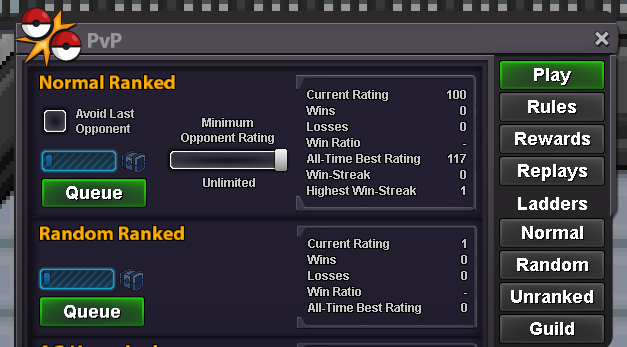
I'm going to try to reach 200 Rating in PvP. Normal Ranked, Random Ranked, or both. Getting there comfortably in one would be a good start. I'm not good at PvP. I'm 35, from the UK, grew up with Gen 1 and 2, and most of my time in PRO has been spent on PvE and auctions (I'm more of an auctioneer than a PvPer). Competitive Pokémon has never interested me enough to properly learn it. So while everyone starts at 100 Rating, in terms of PvP experience, I'm starting from zero. And that's why I'm making this thread. There are PvP guides written by players who could probably reach 200 half asleep, but I want to document the journey from the other side: Can someone who doesn't know what they're doing learn PvP and reach 200? I'll post my rating, the teams I'm using, mistakes I'm making, things I'm researching, videos and guides I'm watching, advice people give me, what helps, what doesn't, and how my thinking changes as I get more experience. And I'll include the bad stuff too. If I get to 150 and crash back to 70, that's going in here. If I spend time building a team only to discover I've made myself weak to something obvious, that's going in here too. I'm not trying to teach people how to PvP. I'm trying to learn how to PvP. And maybe that's what could make this useful to another new player. Instead of someone who's been playing competitively for years telling you to "just do X", you'll be watching someone who might currently be worse than you trying to understand why X matters in the first place. The goal isn't to hit 200 once because I went on a lucky run. I want to get to the point where 200 feels comfortable. If I drop below it, I want to know I can get back there because I've improved, not because I happened to get lucky with a few matches. If I can do that, maybe this eventually becomes Road to 300. But that's getting ahead of myself. 100 to 200. One step at a time.
-
That’s fair too. Good suggestion if there’s enough interest in it.
-
The PvP Viability Rankings are a guide to which Pokémon are considered the strongest/most effective in the PvP meta. They aren't based purely on usage, but on how well each Pokémon performs, what it offers a team, and how it matches up against the rest of the meta. So, here's an idea for a different kind of season: Ban every Pokémon currently ranked from S through C-. Not because they're broken or deserve permanent bans, but as a one-season experiment. Take away the established meta and see what players come up with. Pokémon that are normally overlooked might have a place, and people would have to experiment with different teams, sets, cores and strategies instead of falling back on the usual options. Would it be balanced? Maybe not. Would it be chaotic and weird? Probably. But that's the point. Either way, it would be something different. Current PvP viability list can be found here: https://pokemonrevolution.net/forum/topic/249948-pro-pvp-viability-rankings-updated-on-05122026/
-
Of course, that too. Apply it across all aspects of gameplay.
-
I think it would be helpful to add an indicator during PvP battles showing whether a move is Not Very Effective, Effective, or Super Effective against the opposing Pokémon. This is something we already see in newer mainline Pokémon games, where the game helps players understand which moves are effective against the Pokémon they're facing. I think this could be especially useful for newer PvP players in PRO. There are a lot of Pokémon, typings, and dual-type combinations to learn, and expecting newer players to remember every matchup can make getting into PvP overwhelming. Having this information shown when selecting a move would help players learn type matchups naturally through their battles. Over time, they would start remembering these matchups themselves and improve their overall PvP knowledge.
-
@Xixev For older players, the precise join time may simply not be available anymore, especially going back to 2015 when it may not have even been recorded. You have the right to ask, but I doubt they’ll make an exception for what is a cosmetic/OCD-related request. My join time displays the same as yours, and I’m not nearly as old a player as some. You could take it further, why 09/15 but not 10/10, or all even numbers? I understand the OCD side of it to some extent, but I just don’t see them accommodating requests like this.
-
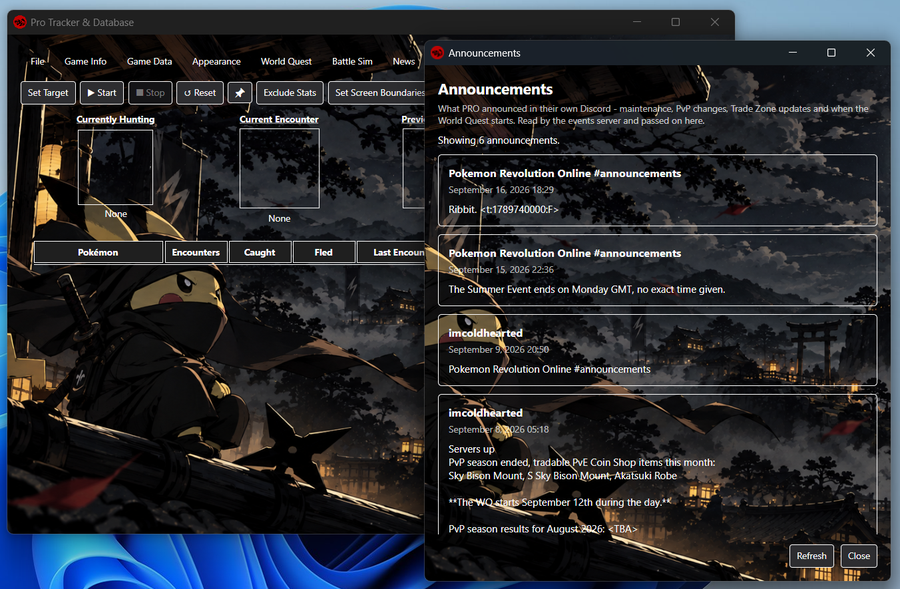
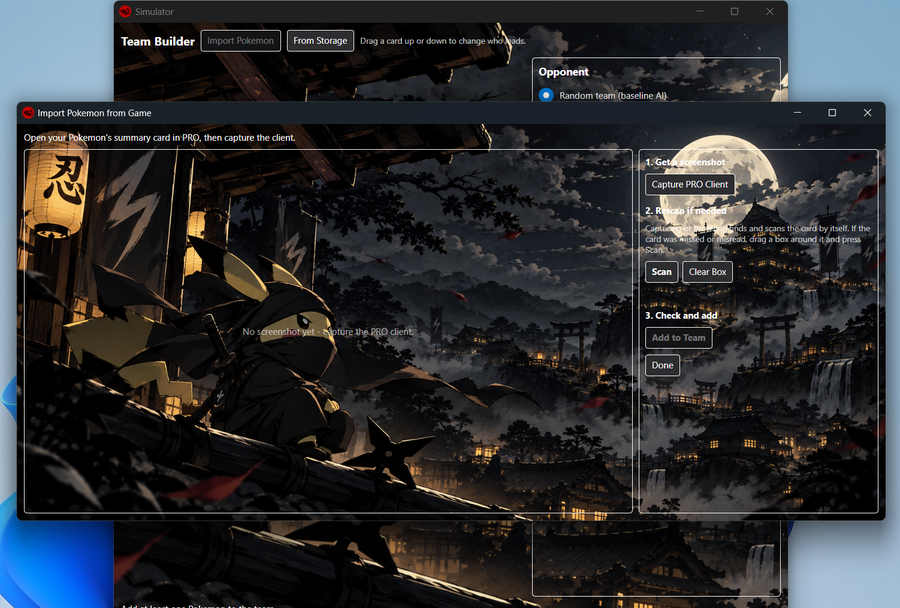
Outside of the countless other features, my personal favourite has to be the Auction Tracker. Track bids, bidders, prices and auction history. The app is essentially an all-in-one Pokémon companion. Track encounters and catches, build and test teams, simulate battles, manage your Pokémon, follow announcements, and keep everything organised in one place.
-
Having a hard time giving this a straight +1 or -1. The suggestion is reducing the current 7-day period down to 3 days. In practice though, that means asking Trade Moderators to step in sooner. I can understand the argument that this would get sellers their Pokédollars faster, but at the same time, what if another seller simply isn't ready within those 3 days for whatever reason? The current 7 days gives both sides a decent amount of breathing room without anyone having to get involved (vice versa, whether it's the buyer or the seller, I think 7 days is a reasonable amount of time for either side to get things figured out). The other part I'm unsure about is allowing the buyer and seller to mutually agree to extend it from 3 days back to 7. I understand the idea behind it and why that sounds more flexible, but I don't really think the players should be the ones making that call. If both sides agree to an extension, now the Trade Moderators have another thing to deal with. They may have to verify that both people agreed, check Discord or in-game messages, deal with disagreements over what was said, etc. That's my concern with the suggestion. It may sound easier or more convenient, and I understand the benefits pointed out, but it also introduces extra work/potentially more situations for moderators to sort out. I also think going from 7 days to 3 days could end up benefiting one side more than the other depending on the situation (under a lot of circumstances). Then adding a mutual extension system on top of that feels like we're creating another process just to compensate for shortening the original one. So I can't really say it's a definite -1 because I understand why some would want it, but I'm not convinced it's worth changing the current system either. If I had to lean one way, I'd probably lean against it. The 7-day period might be slower, but it's simple, gives everyone enough breathing room, and doesn't create another headache for Trade Moderators to deal with.
-
+1 and -1. To revert back to allowing the owner to post the bid on a player's behalf...I get it. Sure, that's fine, and I can understand why some would prefer it that way. In theory, having both options may be the best of both worlds. But there's a reason we moved away from the old system. Screenshots can be disputed, taken out of context/faked, arguing over who bid what. The current system removes that grey area. The player logs in, places the bid themselves, and it's there for everyone to see. It's cleaner, more transparent and far easier to verify. Sometimes what seems more convenient isn't necessarily what's better for the system overall. Having the option to place a bid in-game and have it automatically reflected on the forum would be nice. The problem is that it would probably require additional coding to make sure the bid is accepted in-game and then correctly translated and displayed on the forum. That's more work to add to an already existing system, maybe it's something that happens later. For now though, I don't really see the current system as much of an inconvenience. Logging into the forum and placing a bid takes a matter of seconds. I'd understand the frustration if it were a lengthy/complicated process, but it really isn't. It just requires some willingness from the player to log in and post the bid themselves. Having both options might be nice. At the same time, I don't think the new setup is asking too much of anyone either. For the time being, I think it works well enough.
-
This is just a personal take regarding the presentation of auctions and in particular the growing use of AI or other tools to illustrate what is being sold. I've noticed that some players are starting to use AI-generated images or similar methods to showcase Pokémon in their auctions. While I can understand the appeal, these images can look impressive, dramatic and naturally draw more attention to a sale, I think there is a problem with using them. I love using AI myself, and I think it has plenty of benefits, whether that's just for fun or for professional purposes. But I also think there's a time and place for it, and when it comes to something like a forum auction, I feel it starts getting into risky territory. The main issue for me is accuracy and consistency. AI-generated images don't always represent the Pokémon being sold exactly as it appears in-game. An image might get a number wrong, display an ability or detail incorrectly, or make some other small change that isn't immediately obvious. Even if the mistake is minor and completely unintentional, it can still create confusion because the image is presenting something that may not be an exact representation of what the player is actually selling. That's where I think AI could unintentionally become a trouble-causer. It doesn't necessarily require anyone to have bad intentions. A seller might simply want to make their auction look more attractive, but an AI-generated image could introduce an incorrect detail that the seller themselves doesn't notice. Then you potentially have disagreements over what was advertised, what a buyer thought they were bidding on, or whether something was misleading. It also leaves moderators having to judge situations that could have been avoided in the first place. Of course, we already have rules against scamming, deliberately misleading or deceiving players, and manipulating information. My suggestion isn't aimed at intentional deception though. It's more about preventing these grey areas and having a consistent standard for everyone before the use of AI and similar tools becomes more common. I think a simple solution would be to require that when visually showcasing the Pokémon being auctioned, players use a direct in-game screenshot from PRO of the Pokémon on offer. AI-generated images or images produced through third-party tools shouldn't be used as a substitute for that. This wouldn't stop people from making their auctions look appealing through formatting or general presentation. It's about making sure that when you're showing the Pokémon being sold, what the buyer sees comes directly from the game and is an accurate representation of what they're bidding on. AI is a great tool and I'm certainly not against its use, but I think auctions are one of those situations where keeping things simple, direct and verifiable is probably better for everyone. Having a clear standard now could save both players and moderators a lot of confusion and disputes later on, especially as AI and similar tools become more used.
